Elsa Ermer, Ph.D. uses an fMRI scanner to analyze psychopaths鈥� brain activity in a quest to understand how best to treat psychopathy.
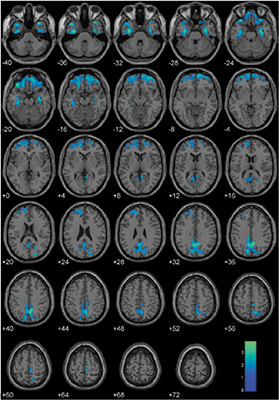
Brain scans reveal that people with higher psychopathy scores have less gray matter (brain tissue that correlates with abilities and intelligence) in the regions colored blue. The color bar shows the scale of the effect. Areas that are more green are the regions where psychopaths showed greater differences from controls.
Picture this.听You鈥檙e in Nazi Germany hiding with your baby and the members of your town. Your baby starts crying. If your baby keeps crying, the Nazis are going to kill everyone. What is the moral choice?
If you鈥檙e struggling with the answer, you鈥檙e not alone, says Elsa Ermer, Ph.D., an assistant professor at the . In her research into social cognition, Dr. Ermer has found that most people are slow to respond to this question and similar ones that test moral reasoning. Most of us have two decision-making systems鈥攁n emotional one that in this case tells us not to harm others and a rational one that tells us it鈥檚 better to save more lives. 鈥淧eople feel that conflict and then it takes them a while to decide what鈥檚 right,鈥� Dr. Ermer says.
Dr. Ermer and Kent Kiehl, Ph.D., a professor at The University of New Mexico, have been asking incarcerated psychopaths how they would act in the Nazi scenario. Dr. Ermer and Dr. Kiehl bring a functional magnetic resonance imaging (fMRI) scanner to prisons to analyze psychopaths鈥� brain activity while they respond. In general, psychopaths choose to sacrifice the baby to save the town, and they decide much more quickly. Their 鈥渆motional system is either damaged, not working or just working at a lower level so it鈥檚 that rational calculus that鈥檚 taking over,鈥� Dr. Ermer says.
Prior fMRI research on psychopaths has revealed that they have less tissue in their paralimbic cortex鈥攑art of the brain where emotions are processed. People with psychopathy also show reduced activity in these areas when making moral decisions.
The moral reasoning experiments are part of a series of studies that Dr. Ermer and Dr. Kiehl are undertaking with the ultimate goal of understanding how best to treat psychopathy. While psychopaths constitute just 1 percent of the general population, they represent 15 to 20 percent of the prison population.
For further information, please contact:
Todd Wilson
Strategic Communications Director听
p 鈥� 516.237.8634
e 鈥� twilson@adelphi.edu