When the Center for African, Black and Caribbean Studies asked Jon Duff, Adelphi exhibitions and art collection curator, to curate an exhibition in honor of Black History Month, he immediately thought of multimedia artist Coby Kennedy.
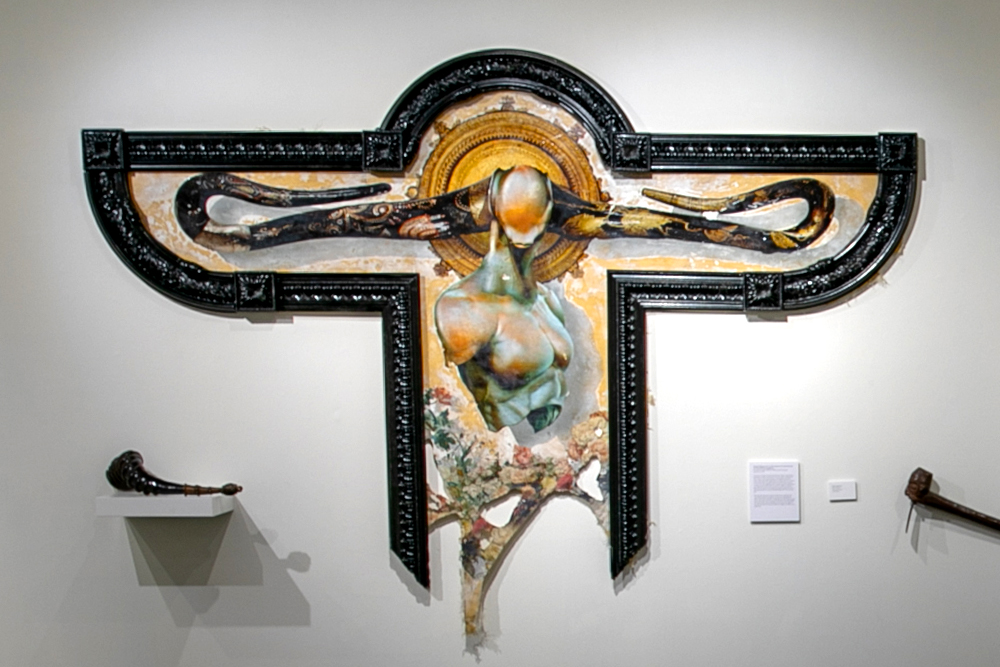
When the Center for African, Black and Caribbean Studies asked Jon Duff, Adelphi exhibitions and art collection curator, to curate an exhibition in honor of Black History Month, he immediately thought of multimedia artist Coby Kennedy. “His work has always stood out to me because it remains personal even though it represents the very broad topic of the contemporary African  American condition,” Duff said. “His work is also just so weird.”
Kennedy’s show in the Ruth S. Harley University Center Gallery,听Empire of Mythology,听doesn’t disappoint in departing from what Kennedy calls the 鈥渂oilerplate” approach to Black History Month, something he said 鈥渘eeds to be disrupted.”
He does this by branching away from 鈥渨hat’s expected from Black History Month,” as he put it, to take a 鈥渕ythical approach to the dynamic of culture and race and reality. The narrative I’m weaving is an inevitable future of where we’re going and a straight perception of how I see society today. It’s the past, present and future depicted in this era…a perversion of what’s going on right now narratively told from the future. It happens some other where and some other when.”
One of the figures in Kennedy’s mythology is a horned, faceless black deity Kennedy calls Jim Crow. Depicted in images such as听Portrait Of James Crow As They Appeared To Coby Kennedy On The Field Of Armageddeon,听the creature is a reflection of Jim Crow laws, colorism and the generational trauma passed on to the black Western diaspora.
Kennedy eschews traditional canvases for bulletproof Kevlar. 鈥淵ou can weave it, laminate it, layer it,” he said. There are layers of meaning to the material as well, a 鈥渨eighted history…war, drugs, gender and politics,” he said. 鈥淭he idea of integrating it into my work was amazing.”
The show also features video and sculpted metal street signs from Fulton Avenue, Malcolm X Boulevard, Bedford Avenue and other streets in Brooklyn, New York, where Kennedy grew up. He cut and repurposed the signs as a mandala and weapons, which, in听Empire‘s narrative, the oppressed used against their oppressors.
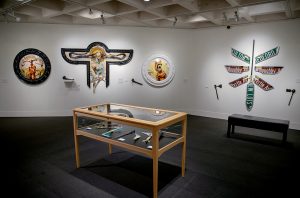 Kennedy’s mythological creations are joined by artifacts from Adelphi’s Archives and Special Collections. “We have a large assortment of African objects in our collection without much information regarding their history or origin,” said Duff. “I asked Coby if he would like to incorporate any of the items in his exhibition, thus directly connecting his works to the African heritage they take inspiration from.”
The show opened on February 1 and runs through April 5, 2019. The public is invited to hear more about Kennedy’s work and ethos from the artist himself at a reception on Sunday, February 24, from 3:00 p.m. to 4:00 p.m.
“I was grateful to have the opportunity to collaborate with him,” said Duff. “Finding an artist that can create something so weird and unexpected to create an unforgettable experience is difficult, and to find someone who can do that while approaching important political topics is incredibly rewarding.”
For further information, please contact:
Todd Wilson
Strategic Communications Director听
p 鈥� 516.237.8634
e 鈥� twilson@adelphi.edu