Subadra Panchanadeswaran, Ph.D., uses her social work skills to help Sakhi for South Asian Women advance its mission.
Bithi Roy, domestic violence program advocate, and听Subadra Panchanadeswaran, Ph.D., an associate professor in the 天美传媒 School of Social Work, traveled different paths to arrive at their current roles at听. Roy came to Sakhi six years ago, after earning her master鈥檚 degree in criminal justice. Dr. Panchanadeswaran is the academic who has researched various aspects of GBV for the past 20 years among varied populations, including female sex workers in India, substance-using women in the United States and South Asian immigrant women in New York City.
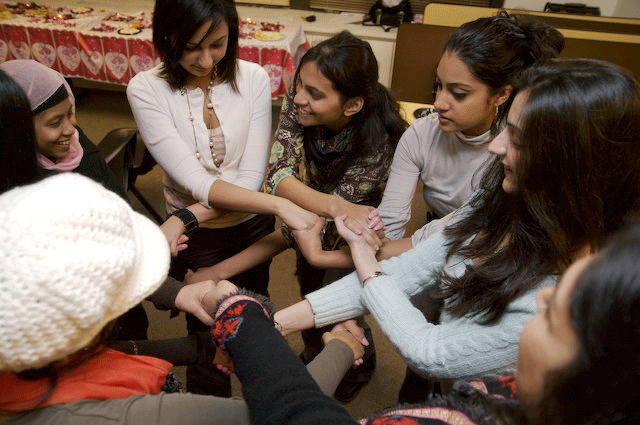
Sakhi for South Asian Women provides support and services for survivors of domestic violence and their families, including this youth group for teen girls.
Roy explained that since domestic violence is a stigmatized issue in the South Asian community, South Asian immigrant women who endure various forms of physical, verbal, psychological, economic and/or sexual abuse from their partners are often afraid to speak out. Compounding the problem is fear of deportation and lack of proficiency in English. Far from home and family, these women feel fearful, hopeless and isolated.
Sakhi for South Asian Women has been a lifeline for such women for the past 25 years. Armed with a small staff and a band of committed volunteers who are multilingual, Sakhi fields phone calls on its helpline, offers crisis counseling, English language and computer literacy classes, support groups and many other vital services. Women who feel isolated receive vital emotional support from Sakhi volunteers, staff and, ultimately, one another.
In 2006, Dr. Panchanadeswaran began volunteering for Sakhi, accompanying women to public assistance offices and helping to run support groups, among other tasks, while continuing her faculty responsibilities at Adelphi. Subsequently, she was recruited to Sakhi鈥檚 board of directors to head up the program subcommittee. 鈥淭his experience at a grassroots level has enabled me to see the big picture,鈥� she said.
Dr. Panchanadeswaran does not issue edicts from the proverbial academic ivory tower. 鈥淥ne of the key tenets of social work practice is meeting the clients where they are,鈥� she explained. 鈥淲e need to meet the organizations where they are. I truly believe academics should be engaged in community service on a regular basis and understand what the organizations need, not what we need.鈥� Based on her assessment of Sakhi鈥檚 needs, she spearheaded听 initiatives to move the organization forward, some of which are outlined here:
- Roy pointed out that important information related to survivors鈥� needs and experiences was not being captured at the outset. 鈥淪ubadra played a huge role in helping us improve the client intake process. Now we have data that we can use to improve our services.鈥�
- Since Sakhi does not have the funds to subscribe to academic databases and staff members do not have the time to read peer-reviewed articles on subjects that may benefit survivors, Dr. Panchanadeswaran sums up lengthy reports and periodically sends relevant journal articles to staff. 鈥淚t鈥檚 impossible to advocate for women鈥檚 needs if we don鈥檛 have solid research backing up the claims,鈥� she said.
- Dr. Panchanadeswaran鈥檚 colleagues from the in Baltimore used the LEAN approach to quality management to help staff identify practices that waste time and energy, thus optimizing performance and gaining hours to serve their clients.
- Sakhi staff attended a two-day training in trauma-focused cognitive behavioral therapy (TF-CBT) provided by the 天美传媒 School of Social Work Institute for Adolescent Trauma Treatment and Training (see p. 5), co-directed by Mandy Habib, Psy.D., and Victor Labruna, Ph.D. As a result, Roy said she now understands the mind-set of a woman in crisis and has the tools to 鈥渋nspire her to move forward, to look at the future.鈥�
- In her interactions with Sakhi staff, Dr. Panchanadeswaran felt that given the intense nature of their work with survivors, there was a need to address issues of vicarious trauma. She introduced a colleague from the , Laura Quiros, Ph.D., an assistant professor. Dr. Quiros provided an overview of the complex issues related to vicarious trauma to help Sakhi staff understand their own role in the helping process and recognize issues of burnout and the importance of self-care.
In Fall 2013, Dr. Panchanadeswaran arranged for听 Monica Sharma, a senior in the B.S.W. program, to intern at Sakhi. Sharma came to the United States from India at age 18. She left behind family troubles and painful experiences and brought her passion for helping women. At Sakhi she began working with a young Bangladeshi woman with an abusive husband. Over the next few months, Sharma was instrumental in helping her client find the strength to leave her husband and enroll in community college.
Sharma鈥檚 internship turned into a full-time job as an economic empowerment coordinator at Sakhi. 鈥淚 would not be where I am today without Subadra鈥檚 help,鈥� she said.
鈥淪eeing passionate people like her makes me more passionate than I am and gives even more meaning to what I鈥檓 doing. 鈥淭hese women are concerned about their children and what their family and community will think,鈥� she continued. 鈥淚 tell them, yes, think about other people, but if you鈥檙e miserable, you cannot put a smile on someone else鈥檚 face.鈥�
Life isn鈥檛 easy for an immigrant woman who leaves her husband to support herself, and often her children, on her own. 鈥淏ut we have seen women鈥檚 lives become violence free,鈥� Dr. Panchanadeswaran said. 鈥淭here is a significant change in the quality of life in that.鈥�
As the recipient of the Fulbright-Nehru Scholar Award for 2014鈥�2015, Dr. Panchanadeswaran plans to conduct a multicity investigation in India on the myriad ways in which cellphone technology has influenced sex work and examine the challenges and opportunities for the development of HIV prevention among female sex workers.
|
Monica Sharma (far left), with Bithi Roy (fourth from right) and other celebrants . |
 Dancers at the Sakhi gala. |
|
Bithi Roy (left), with Subadra Panchanadeswaran, Ph.D. |
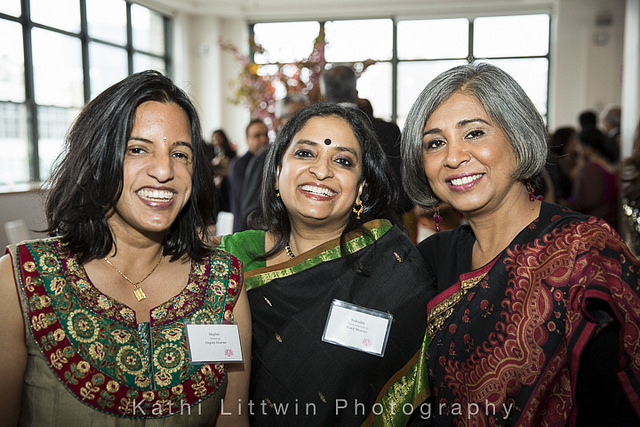 From right: Sakhi Deputy Director Shalini Somayaji, Subadra Panchanadeswaran, Ph.D., and honoree Urmi Basu, founder of New Light |
For further information, please contact:
Todd Wilson
Strategic Communications Director听
p 鈥� 516.237.8634
e 鈥� twilson@adelphi.edu